
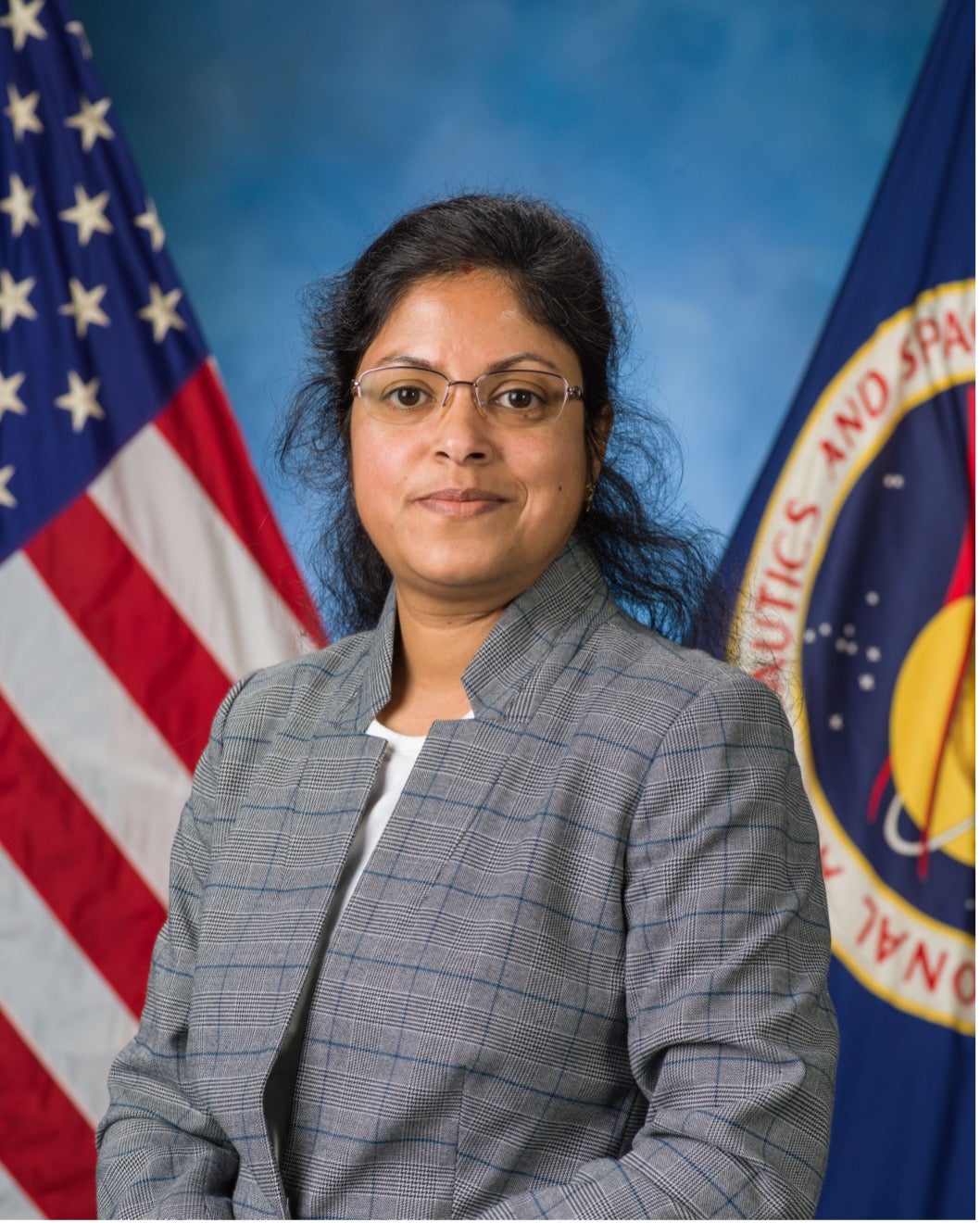
When Jayati enrolled in the Rice PSM Bioscience and Health Policy track, NASA was nowhere on her radar. A former bench researcher looking to stay connected to science through a policy lens, she found her way to an internship at Johnson Space Center and never looked back. Today, Jayati serves as Portfolio Integrator within NASA's Human Factors and Behavioral Performance Element. We sat down with her to learn how a BHP degree can take you places you never expected.
You completed the Bioscience and Health Policy track. At the time, did you see yourself ending up at NASA?
My career definitely took a direction I did not initially expect. After completing my doctoral and postdoctoral research career, I was looking for a path that would allow me to stay connected to the scientific world without doing bench research. Living in Houston and being surrounded by one of the largest medical sectors, I became particularly interested in understanding health policy and how it could be applied within the healthcare environment, which led me to Rice's PSM program. When I joined the Bioscience and Health Policy track, a future at NASA was nowhere in my plan.
My career path took an unexpected turn in 2018, when I began an internship at NASA. I quickly learned how essential crew health and performance are to mission success. Discovering this field and seeing how my background could contribute was a surprising and rewarding direction in my career. NASA has become a place where my skills, curiosity, and purpose intersect in ways I could not have imagined when I first began the program at Rice.
What was one experience from the Rice PSM that you still draw on in your work today?
It is difficult to point to just one aspect of the program, because the overall experience shaped how I think and work today. The program taught me how to combine technical knowledge with policy awareness, and this combination guides the way I approach complex problems, collaborate with colleagues from different fields, and support human health and performance work at NASA.
In my previous research career, I often worked independently, so the project-based assignments in the Rice PSM program were especially valuable because they taught me how to work collaboratively in a team environment. The management courses at the Jones School also provided important leadership training that I had not received before.
How did the PSM's bridge between science and professional practice prepare you for a place like NASA?
The PSM program helped me learn how to move between scientific detail and real-world decision making, which is essential at NASA. The curriculum pushed me to think beyond the lab and understand how science fits within policy, management, and operational constraints.
That combination of scientific training and practical, policy-focused thinking prepared me well for the environment at NASA, where decisions must balance evidence, risk, resources, and mission timelines. The PSM program gave me the ability to translate scientific insight into actionable steps, which is central to supporting human health and performance work.
Walk us through the journey from graduation to where you are now.
I wanted to stay close to science but move beyond bench research. While searching for internship opportunities, I came across a position with NASA's Human Specimen Repository project. Even though the project itself seemed straightforward, I saw it as an opportunity to gain exposure to a world-renowned organization and to explore an area that was completely new to me.
Once I began my internship, everything changed. Attending seminars and interacting with teams across NASA opened my eyes to the vast world of space science. I quickly realized that space research is not limited to engineering; there are critical roles for biological science, human health, and policy. That exposure inspired me and helped me see where my background could meaningfully contribute.
One of the most pivotal moments was being offered a position with the Human Research Program's Human Factors and Behavioral Performance Element before my internship ended. Joining their science management team gave me the opportunity to apply my combined training in science, policy, and project management in a way that directly supports human spaceflight. That step was the true bridge that took me from health policy into the space sector.
What does your day-to-day work at NASA actually look like?
Most people picture NASA astronauts, rockets, and dramatic countdowns. In reality, my day-to-day role is much quieter but essential for helping to keep human spaceflight safe and scientifically grounded. I serve as Behavioral Health and Sleep Portfolio Integrator within the Human Research Program’s Human Factors and Behavioral Performance (HFBP) Element, helping ensure the science that keeps astronauts safe is well managed and mission-ready.
As a Portfolio Integrator I play a critical role in supporting the Element Management science coordination for the HFBP Element. The contributions are essential for the successful implementation of the Element’s overarching objectives. I act as the primary liaison between NASA’s science management team and the research community, both within and outside of NASA, overseeing the projects with effective coordination throughout its tenure; ensure desired deliverables contribute to HRP’s knowledge gaps to help buy down risks associated with spaceflight missions and to critical program milestones.
A typical day involves guiding both NASA and external research teams, making sure every study stays aligned with NASA’s strategic goals. Much of my time is spent talking to PIs to get regular updates on science accomplishments and discuss issues and concerns that need attention to help them execute the science objective without any major interruption. From the project management aspect tracking budgets, schedule, study milestones, and deliverables so that each project contributes meaningfully to closing HRP’s knowledge gaps and advancing NASA’s path to risk reduction.
So, reality is less Hollywood spectacle and more focused, behind the scenes orchestration. My job is to make sure the science that keeps astronauts safe is well managed, well integrated, and delivers exactly what mission planners need for success.
Artemis II is a genuine milestone for human spaceflight. What does this moment mean to you?
As a proud Rice Owl now working at NASA, Artemis II represents both a professional milestone and a deeply personal moment of reflection. It is an honor to help carry forward a legacy that began on our campus with President Kennedy's "We choose to go to the Moon" speech in 1962 at Rice Stadium. Standing at NASA as Artemis II comes to life, it feels like witnessing that legacy evolve in real time.
Personally, this moment affirms why I pursued this path. Artemis II is the first time in more than 50 years that humans have traveled beyond low Earth orbit, and being even a small part of the teams contributing to this mission fills me with pride and gratitude. For the broader arc of space exploration, Artemis II marks a turning point. It is a bridge between the Apollo generation and the next era of sustainable deep space exploration. This mission prepares us for Artemis III and beyond, paving the way for long-duration lunar presence, scientific discovery, and eventually crewed missions to Mars.
What skills from the BHP track have translated most unexpectedly well into your NASA work?
One of the most unexpectedly transferable skills has been the ability to navigate complex, interdisciplinary systems. In policy work, you learn to translate scientific details into operational decisions, and that skill has been invaluable at NASA. Whether I'm evaluating mission risks, shaping program strategy, or coordinating across science and operations teams, the ability to synthesize data, anticipate downstream impacts, and communicate clearly has been a major asset. In policy, you are constantly balancing scientific rigor with real-world constraints, and that mindset translates beautifully to mission planning. I did not expect that background to provide such a strong foundation for navigating the complexity of space missions, but it has turned out to be a perfect fit.
What's one piece of advice you wish someone had given you when you were finishing the PSM?
I wish someone had told me that your first job doesn't define your entire career. When I finished the PSM program, I felt pressure to find the "perfect" role immediately. In reality, the most important thing is to choose an environment where you can learn quickly, ask questions, and build transferable skills. The path becomes clearer once you're in motion. Focus less on job titles and more on the problems you want to solve. Once you start choosing roles based on impact rather than labels, the right opportunities come naturally.
Is there anything you're working on or excited about that you'd want fellow alumni to know about?
I am excited about the growing need for people who can bridge scientific insight with operational decision-making. It is still an under-developed space, and PSM graduates are uniquely positioned to lead in it.
Finish this sentence: "The thing about working in space that nobody tells you is..."
"...how spaceflight missions are full of unknown unknowns."