
Advancing Environmental Restoration and Sustainability in Houston!
Turning classroom knowledge into meaningful environmental impact!
Meet Su Su, a student in Rice University's Master of Science in Environmental Analysis (MSEA) program, who is making a difference in environmental conservation through hands-on field research, data analysis, and community-focused restoration efforts.
Through her summer internship with Houston Wilderness, Su Su gained valuable experience evaluating urban tree restoration projects and contributing to efforts that support a healthier, more sustainable Houston.
Environmental Research That Makes an Impact
From May through July 2026, Su Su completed her summer internship as a Tree Assessment Intern at Houston Wilderness, where she participated in the Houston Ship Channel and Adjacent Ports (HSC+AP) TREES Program. This initiative focuses on environmental restoration in the Houston Ship Channel region and surrounding port communities.
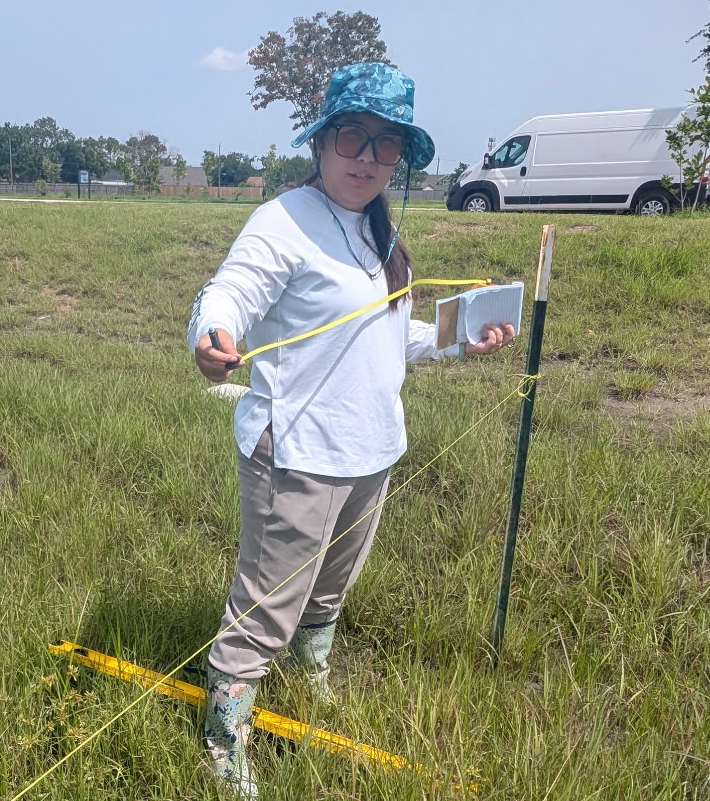
As part of her internship, Su Su visited tree planting sites throughout Houston to conduct tree survival assessments, collect soil samples, and evaluate bioswales, which are landscaped areas designed to manage stormwater runoff. She also analyzed environmental data using RStudio, organized field research findings, and prepared reports and presentations to communicate her results.
Through these responsibilities, Su Su strengthened her skills in environmental field research, data analysis, critical thinking, and problem-solving while gaining firsthand experience with the challenges and opportunities involved in environmental restoration.
From Field Research to Community Impact
For Su Su, one of the most rewarding aspects of her internship was seeing how environmental restoration initiatives can positively impact local communities. By visiting planting sites, assessing tree survival, and evaluating environmental conditions, she gained a deeper understanding of the factors that contribute to successful restoration projects. Her work also demonstrated how collecting and analyzing environmental data can help inform future conservation and sustainability efforts.
"The most meaningful part of my internship was seeing how environmental restoration projects can make a real difference in local communities." Su Su especially enjoyed the opportunity to work independently, analyze the data she collected, and see how her findings could support future restoration projects.
"It was especially rewarding to analyze the data I collected and understand how our work could support future restoration projects. I also enjoyed having the opportunity to work independently and apply what I learned in class to real environmental challenges."
Why Rice's Environmental Analysis Program?
Su Su credits Rice University's Environmental Analysis program with helping her bridge the gap between academic knowledge and practical environmental work. Through coursework in environmental science, sustainability, and data analysis, she developed technical and analytical skills that she was able to apply directly during her internship at Houston Wilderness.
Her experience using RStudio was particularly valuable, allowing her to organize, evaluate, and interpret tree assessment data collected in the field. "The MSEA program at Rice University has helped me connect classroom knowledge with practical environmental work. Courses in environmental science, sustainability, and data analysis provided useful skills that I applied during my internship at Houston Wilderness." Beyond technical knowledge, the program has helped Su Su strengthen her research, communication, critical thinking, and problem-solving abilities, preparing her to address complex environmental challenges.
Looking Toward a Future in Environmental Sustainability
Su Su hopes to build a career in environmental management, conservation, and sustainability, applying her scientific knowledge and practical experience to support environmental protection and restoration efforts. Her internship reinforced the importance of combining field research with data-driven decision-making to develop effective environmental solutions.
By connecting scientific analysis with real-world environmental challenges, she is building the foundation for a career focused on protecting natural resources, supporting sustainable practices, and making a positive impact on communities.
Her Advice to Future PSM Students
"Take advantage of the opportunities available at Rice University, especially internships, research projects, and connections with professionals." Su Su encourages prospective students to seek practical experience early, develop valuable technical skills, and explore different areas of environmental science to discover their interests and career goals. She emphasizes the importance of strengthening skills in data analysis, field research, and communication, as these are essential for addressing environmental challenges in professional settings. "The program can be challenging, but it provides valuable opportunities to connect academic knowledge with real-world experience."